
Concrete Repair Denver — Commercial & Industrial Slab Restoration
Joint Repair, Crack Filling, Dock Edge Repair, Cementitious Patching, and Substrate Correction for Active Facilities
Colorado Concrete Repair restores damaged commercial and industrial slabs across Denver and the Front Range. We repair broken joint shoulders, open cracks, damaged dock areas, failed epoxy mortar, anchor holes, spalls, step edges, and worn traffic lanes in facilities that often cannot shut down for long. CCR’s current Jobber sheet shows more than 130 repair-related jobs, including more than 50 joint projects and more than 20 crack-related jobs, with scopes involving joint grinding and flattening, Euco Quikjoint UVR polyurea filling, cementitious patchwork, bolt cutting, dock repair, and resinous rebuild work. The goal is simple: restore the slab to dependable service or create the substrate the next flooring system actually needs.
OR, SHARE YOUR PROJECT DETAILS:
130+ Repair Jobs
Repair history across warehouse, food, manufacturing, municipal, school, commercial, and clean-support environments throughout the Front Range.
Joint, Crack & Dock Specialists
More than 50 joint projects and more than 20 crack-related jobs, plus dock repair, step repair, epoxy mortar replacement, bolt fill, grinding, and slab rehab scopes built from real field work.
Front Range Coverage
Denver metro core with repair projects spanning food production, warehousing, industrial plants, schools, municipal work, and technical facilities across Colorado.
COMMERCIAL CONCRETE REPAIR
Repair Work That Starts With the Slab, Not the Sales Pitch
Most damaged commercial floors do not fail in a dramatic way. They get rougher at the joints, start popping at the edges, collect dirt in open cracks, hold water in damaged dock sections, or expose old anchors and patching that forklift tires keep finding. Eventually the floor becomes a safety issue, a maintenance issue, a sanitation issue, or a problem for the next finish system. Concrete repair is the work of solving those failures correctly before they spread.
CCR’s repair page should not read like a generic patch service because the actual work is broader and more technical than that. Jobber history shows repair-related scopes in food manufacturing, food and nutrition facilities, warehouses, schools, municipal sites, retail and commercial buildings, and technical environments. The work ranges from a small dock repair or step repair to large industrial rehabilitation performed on a time-and-material basis when hidden deterioration and phased access make a simple fixed bid unrealistic.
Recent CCR repair work includes a March 2026 scope combining joint flattening and grinding, Euco Quikjoint UVR dual-component polyurea filler, cementitious patchwork, and bolt cutting with resin-based filling. Other repair history includes bollard repair and refinishing, crack repair, dock repair, step repair, and hole and crack corrections in warehouse, food, municipal, education, and industrial environments.
That is why CCR approaches repair as substrate correction first. If the floor is staying exposed, the repair has to stand on its own under traffic and cleaning. If the floor will later receive epoxy, polished concrete refurbishment, grind-and-seal, or another finish, the repair has to become a stable base for that next step. In both cases, the quality of the cutout, cleanout, edge definition, dust control, mixing, placement, and cure management determines whether the repair lasts or just turns into the next failure to remove.
Repair Scope Snapshot
Repair Jobs
130+
Joint Jobs
50+
Crack Jobs
20+
Typical Tools
Grind · Cut · Vacuum · Pump
Common Markets
Warehouse · Food · Industrial
Repair Types CCR Handles
These are not hypothetical services. They come directly from CCR’s repair and line-item history in Jobber.
01
Joint Grinding, Flattening & Refill
When forklift lanes and hard-wheel traffic start breaking down joint shoulders, the floor gets louder, rougher, and more expensive to maintain. CCR grinds and flattens joints, removes failed filler, cleans out the channel, and refills with the right material for the use case. Euco Quikjoint UVR is part of that real history for active commercial floors that need flexible polyurea performance and cleaner wheel travel.
02
Crack Repair
Open cracks create sanitation issues, hold debris, telegraph through finish systems, and weaken serviceability under repeated traffic. CCR’s repair history includes kitchen crack repair, grout-fill work, and broader crack correction scopes where the method is selected based on the floor’s future use and how the crack is behaving in service.
03
Cementitious Patchwork & Spall Repair
For pop-outs, spalls, holes, broken edges, and general surface loss, cementitious patchwork can restore the slab once weak material is fully removed. This is common in warehouses, schools, commercial buildings, and support spaces where localized damage does not justify slab replacement but still needs a durable correction.
04
Epoxy Mortar Removal & Resinous Rebuild
Some floors already have failed repairs in place. In those cases, the right answer is not another skim patch. It is controlled demolition of the old epoxy mortar or incompatible repair, followed by a rebuild with fast-setting resinous mortar and blending or resurfacing as needed. This type of work is common in active manufacturing and distribution environments.
05
Bolt Cutting, Anchor Removal & Hole Fill
After equipment relocations or tenant changes, floors often end up with anchor bolts, open holes, or patched-over hardware that keeps failing. CCR cuts or removes the bolt, prepares the area correctly, and fills with resin-based material so the slab returns to a smoother, safer service condition.
06
Dock, Step & Edge Repair
Loading docks, transitions, stair edges, and step fronts take impact and weathering that standard interior slab sections do not. CCR’s history includes dock repair for manufacturing and pharmaceutical facilities, municipal step polishing and repair work, and localized edge restoration where service safety is the real issue.
Concrete Repair Methods Compared
Select a repair method to see where it fits, what it solves well, and the tradeoffs to plan around.
Joint Grinding & SealingActive traffic lanes▼
Best for: Broken joint shoulders, rough wheel transitions, and warehouse or production floors where failed filler is allowing edge damage to spread.
Strengths:
- Restores smoother travel across active joints
- Supports edge durability with polyurea refill such as Euco Quikjoint UVR where appropriate
- Fits warehouse, food production, and hard-wheel traffic environments
- Can prevent a small joint issue from becoming wider slab failure
Tradeoffs:
- Does not correct deep structural movement by itself
- Failed or contaminated filler must be removed first
- Material selection changes if the area sees unusual heat or chemical exposure
Crack RepairLocalized slab failure▼
Best for: Open cracks, grout-fill work, kitchen floor cracks, and areas where sanitation, traffic, or future coatings make exposed cracking unacceptable.
Strengths:
- Improves serviceability before cracks worsen under traffic
- Supports coating and refurbishment scopes when substrate correction comes first
- Works for both exposed floors and pre-finish slab prep
Tradeoffs:
- Not every crack should be treated the same way
- Hidden movement or deeper deterioration may expand scope
- Method depends on how the floor will be used afterward
Cementitious PatchingSpalls & surface loss▼
Best for: Spalls, pop-outs, broken edges, general patchwork, and localized surface failure where loose material can be removed and rebuilt without full slab replacement.
Strengths:
- Practical option for common commercial floor surface damage
- Pairs well with broader repair-then-coat workflows
- Can restore damaged areas after proper edge definition and prep
Tradeoffs:
- Weak concrete must be removed completely before patching
- Material must match the environment and next floor system
- Not the right choice for every high-performance or fast-return repair
Epoxy Mortar ReplacementFailed resinous repairs▼
Best for: Older facilities and high-abuse areas where previous epoxy mortar repairs are failing, breaking away at edges, or creating unsafe transitions.
Strengths:
- Removes incompatible or deteriorated repair material instead of covering it
- Uses controlled cut-out and resinous rebuild methods for durable transitions
- Fits food, industrial, and high-abuse environments that need fast-setting repair mortar
Tradeoffs:
- Requires more demolition and edge treatment than basic patching
- Higher cost than simple cementitious repair scopes
- Success depends on compatible rebuild materials and proper finish blending
Surface Grinding / Shot BlastingScope-based · Prep before next system▼
Best for: Damaged, contaminated, uneven, or coated slabs that need mechanical preparation before patching, sealing, recoating, or polished concrete refurbishment.
Strengths:
- Creates the profile required for bond and finish performance
- Blends repairs into the surrounding slab condition
- Supports repair-first workflows before coatings and restoration
Tradeoffs:
- Prep alone does not fix structural slab failure
- Production realities and dust control must be planned carefully
- Scope can expand when hidden weak concrete is exposed
Materials, Methods & Equipment CCR Uses
Repair quality depends on the removal, cleanout, prep, and placement tools behind the scope — not just the patch material in the quote.
Mechanical Prep Tools
CCR’s real equipment history includes diamond blade cut wheels, diamond grinding equipment, shot blasting equipment, joint cleanout saws, and the Baier Floor Channel Cutting System. These tools matter because weak concrete and failed filler have to be removed cleanly before the repair can work.
Dust & Placement Control
HEPA vacuum systems, industrial vacuums, polyurea pumps, mixers, and on-site support equipment keep the work controlled in active facilities. This matters in food production, technology, warehouse, and occupied commercial spaces where repair work cannot just create a larger mess around the damaged area.
Repair Materials
Jobber line items show Euco Quikjoint UVR for joint filling, high-temp silicone sealant where heat exposure is relevant, resin-based patch materials for bolt fills, fast-setting resinous mortar for epoxy-mortar replacement, and cementitious patch materials for broader surface correction.
REPAIR VS. REPLACEMENT
When Repair Makes Sense — and When It Doesn’t
Many owners default to replacement too early, while others keep patching a floor that is beyond patching. The right answer depends on the slab’s real condition.
Repair Is Usually the Right Move When:
- Damage is localized to joints, cracks, edges, holes, or isolated spalls
- The slab is fundamentally serviceable but specific failure points are expanding
- You need to restore traffic safety or sanitation without full demolition
- The next phase is a coating, polish, or grind-and-seal project that still needs a sound substrate
- Downtime and budget make targeted restoration the practical option
Replacement May Be the Better Move When:
- Damage is widespread and extends well beyond isolated failure points
- The slab has systemic movement, deep deterioration, or major elevation problems
- Repeated repairs have already consumed the stable concrete you need to bond to
- The facility’s future use requires a slab condition the existing concrete cannot realistically support
- Opening the floor reveals conditions that make long-term repair impractical
In practice, many projects land in the middle. The floor may not need full replacement, but it does need more than a cosmetic patch. That is where CCR’s combination of repair, grinding, patching, joint work, and prep capability matters. The site assessment should identify the floor’s real path instead of forcing the project into a one-size-fits-all answer.
FREQUENTLY ASKED QUESTIONS
Concrete Repair — Common Questions
Operational, material, and project-planning answers for commercial repair scopes.
What kinds of concrete repair does CCR actually perform?
CCR handles crack repair, joint grinding and flattening, joint sealing with polyurea, cementitious patchwork, epoxy mortar removal and replacement, bolt hole cutting and resin fill, dock repair, step repair, polished concrete refurbishment support, and grinding or shot blasting tied to broader surface restoration.
Do you handle repair work in active commercial and industrial facilities?
Yes. Much of CCR’s repair work is performed in operating facilities where access, phasing, dust control, and coordination matter. Food production, warehouse, municipal, school, commercial, and technical spaces all change how the work is sequenced and contained.
What do you use for joint filling?
CCR uses commercial joint fillers from real project history, including dual-component flexible polyurea such as Euco Quikjoint UVR. In heat-exposed conditions, CCR has also installed high-temp silicone sealant rated to 180°F. The right material depends on the joint’s service conditions, not just the linear footage.
Can you help if a floor has old failed patching or epoxy mortar?
Yes. CCR has real project history removing failed epoxy mortar with diamond blade cut wheels and HEPA dust control, then rebuilding the area with fast-setting resinous mortar and tying the repaired section back into the surrounding floor. Coating over failed repair material is usually the wrong move.
Do you handle bolt holes and anchors left after equipment moves?
Yes. CCR cuts or removes obsolete anchors and fills the area with resin-based patch materials so the slab returns to a more continuous service surface without exposed wear points, loose hardware, or weak patched-over holes.
Why does repair usually come before coatings or polished concrete work?
Because coatings and finish systems do not fix broken joints, weak patchwork, open anchor holes, or failing repair mortar underneath. Repair is the substrate correction phase that protects the performance of everything installed after it. Skipping that step is one of the fastest ways to shorten the life of the next floor system.
Concrete Repair — Decision-Maker Reference Guide
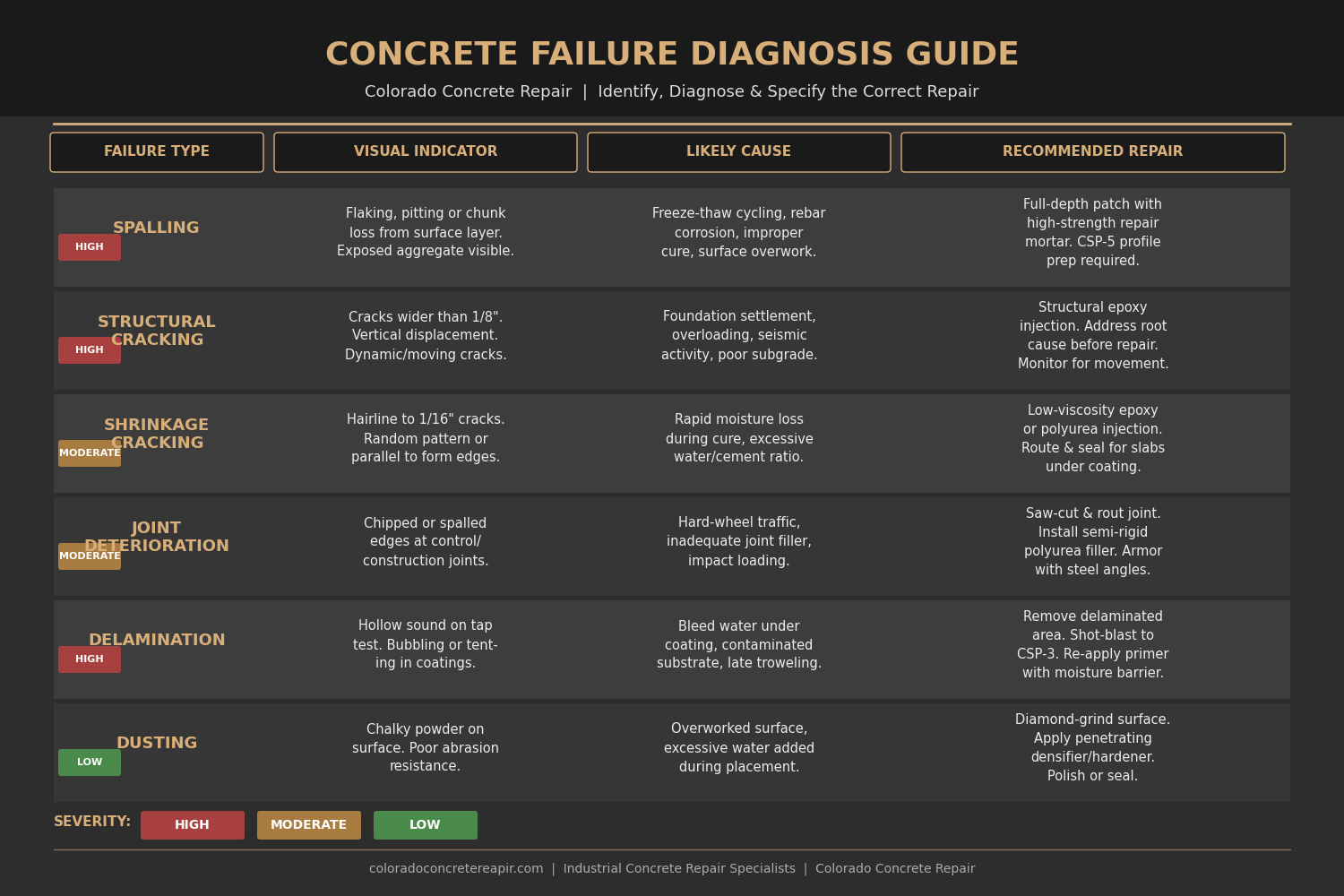
Interactive specification guide — Colorado Concrete Repair
Why Commercial Teams Choose Colorado Concrete Repair
- Commercial and industrial repair scopes built from real field history rather than generic patch-and-paint language.
- Repair method matched to the actual failure — joints, cracks, spalls, failed epoxy mortar, bolt holes, docks, steps, and prep-heavy rehabilitation are not treated as the same problem.
- Preparation-first execution — weak concrete, contaminated filler, and incompatible repair materials are removed before rebuild work starts.
- Dust control and equipment for active facilities — HEPA vacuums, diamond grinding, shot blasting, cut-out tools, channel-cutting systems, pumps, and mixers support controlled repair work where operations continue nearby.
- — fixed bid where conditions are known, time-and-material where hidden deterioration or phased industrial repair makes that the smarter model.
- Works across food, manufacturing, warehouse, clean-support, municipal, education, and commercial environments where sanitation, uptime, access, and traffic patterns all change the repair plan.
- Repair supports the next system — whether the floor stays exposed or moves into coating, grind-and-seal, or polished concrete refurbishment.
- Direct and local — Denver-based contractor with Front Range coverage and a straightforward site-assessment process.
Colorado Concrete Repair
Repair Projects
130+
Joint Projects
50+
Crack Projects
20+
Coverage
Denver + Front Range
Next Step
Site Assessment
Concrete Lifting and Sunken Slab Restoration
Settled or sunken concrete slabs create uneven surfaces, trip hazards, and drainage problems that compound with every freeze-thaw cycle. CCR uses polyurethane foam injection to lift and stabilize sunken concrete slabs without requiring full removal. Polyurethane foam is injected beneath the slab through small drilled ports, expanding to fill voids and raise the slab back to grade. Concrete lifting via foam injection is faster and less disruptive than mudjacking for warehouse floors, loading dock aprons, and commercial flatwork.
Sunken concrete along driveways and sidewalks at commercial properties creates liability and access problems. Uneven driveways and failing sidewalks send the wrong signal to clients, inspectors, and delivery crews. CCR repairs flatwork along commercial property entries, driveways, and pedestrian walkways using repair methods appropriate to each slab condition and scope size.
Quality Concrete Solutions for Garages, Parking Structures, and Commercial Properties
Quality concrete solutions require matching the repair method to the actual failure, not the surface appearance. Garage and parking structure concrete is exposed to stresses that differ from warehouse or production floors: traffic loading patterns, freeze-thaw cycling, deicing salt infiltration, and drainage conditions all contribute to deterioration. CCR’s industry knowledge covers garages, parking structures, loading areas, mechanical rooms, and production zones where repair work must hold under sustained commercial use.
Decorative concrete and stamped concrete that has cracked, faded, or lost definition at joints requires targeted repair approaches. Standard patching does not enhance the texture or color of decorative surfaces. CCR’s repair assessments include decorative and stamped concrete evaluation to determine whether repair or overlay work is the right choice for your next project. Correct diagnosis at the outset is what determines the long-term success of any concrete repair scope.
Schedule a site assessment and CCR will document your specific conditions, identify what matters for your facility’s industry context, and deliver a written scope built from field knowledge — not a generic template estimate. Our repair work is grounded in direct experience across Denver and Front Range commercial and industrial properties.